Periodisation with phases
The 60 programmes are not a list of exercises that stays the same for twelve weeks. They run in phases, and volume and intensity scale with the phase you are in. A build phase asks something different of you than the week before a deload, and the plan should know that.
That is the difference between a plan and a programme: a plan tells you what you do today, a programme knows why today differs from three weeks ago.
Volume autoregulation on landmarks
How many sets per muscle group per week you need is not a fixed number. There is a floor below which you build nothing and a ceiling above which you only eat into recovery. Your working range sits between them.
The app tracks your weekly volume per muscle group against those bounds and adjusts when you drop below or climb above. No model pulling a plan out of the air: a counter with a boundary around it, and a proposal when you cross it.
Double progression, per exercise
Hit the top of the rep range on all your sets and the weight goes up, dropping you back to the bottom of that range. That is double progression, and it works because it makes you earn what you add.
Athverge applies that rule per exercise and makes a proposal the moment you open the exercise, with your previous performance beside it, so you can see where the proposal came from.
The player
Supersets, drop sets, timed sets and myo-reps are in the player itself, not a note you improvise around it. Your previous performance sits in the input field as a ghost value, so you know what you have to beat without paging back.
Log your RPE on your top sets and it genuinely steers the proposal: at RPE 9.5 with your performance down, the engine holds your weight instead of stacking more on. The rest timer is set per exercise and keeps running on Android as a live notification, screen off included. And PR detection is waiting in the summary after your session.
1,311 exercises that know your gym
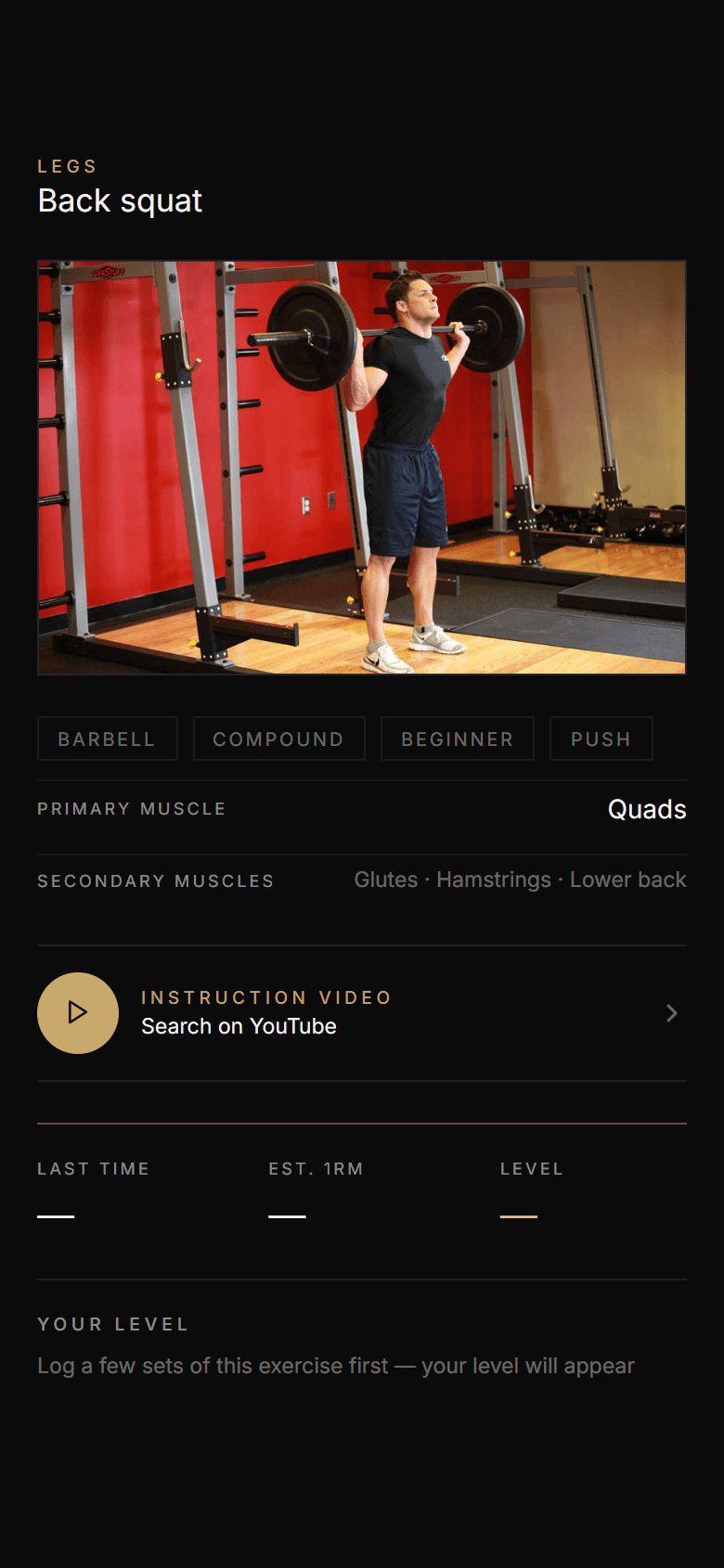
Every exercise has an image and instructions, and an equipment filter keeps you from being offered something your gym does not have. Aliases catch the fact that one machine has three names, all leading to the same exercise.
Unsure about your execution? Film a set and send it to your coach, if you have one. Without a coach that button stays out of sight.
Volume that listens to your muscles
After a session the app asks five short questions per trained muscle group: soreness, pump, workload, performance and joint pain. On those answers the engine adjusts your weekly volume, within scientific lower and upper bounds per muscle group. Joint pain can only slow the volume down, never push it up.
At the end of a block there is a balance: weeks, sessions, tonnage and your strength gain per main lift in e1RM. One button runs the block again, with the volume advice folded in.
"Train now", even without a programme
No active programme and still heading to the gym? One tap generates a session for today, built on your goal, gym or home, the time you have and the muscle groups that are fresh. With the reason attached, so you know why you are getting what you are getting.
Prefer something to hold on to: 10 ready-made blocks of two to four days a week, each with an honest who-this-is-for and, just as important, who it is not.
Switching without losing your history
Your training history from Hevy or Strong and your food diary from MyFitnessPal come with you, via their CSV export. You see a preview of what comes in first, exercises are matched on name, and an import can be undone afterwards.
The same holds the other way: the GDPR export hands you everything. Data you cannot take with you is data that is not yours.
What you see afterwards
A progress graph per exercise, your weekly distribution per muscle group on a radar chart, and your personal records in a list. Enough to see whether you are moving forward and where you are lopsided, without becoming a dashboard that eats an evening.